

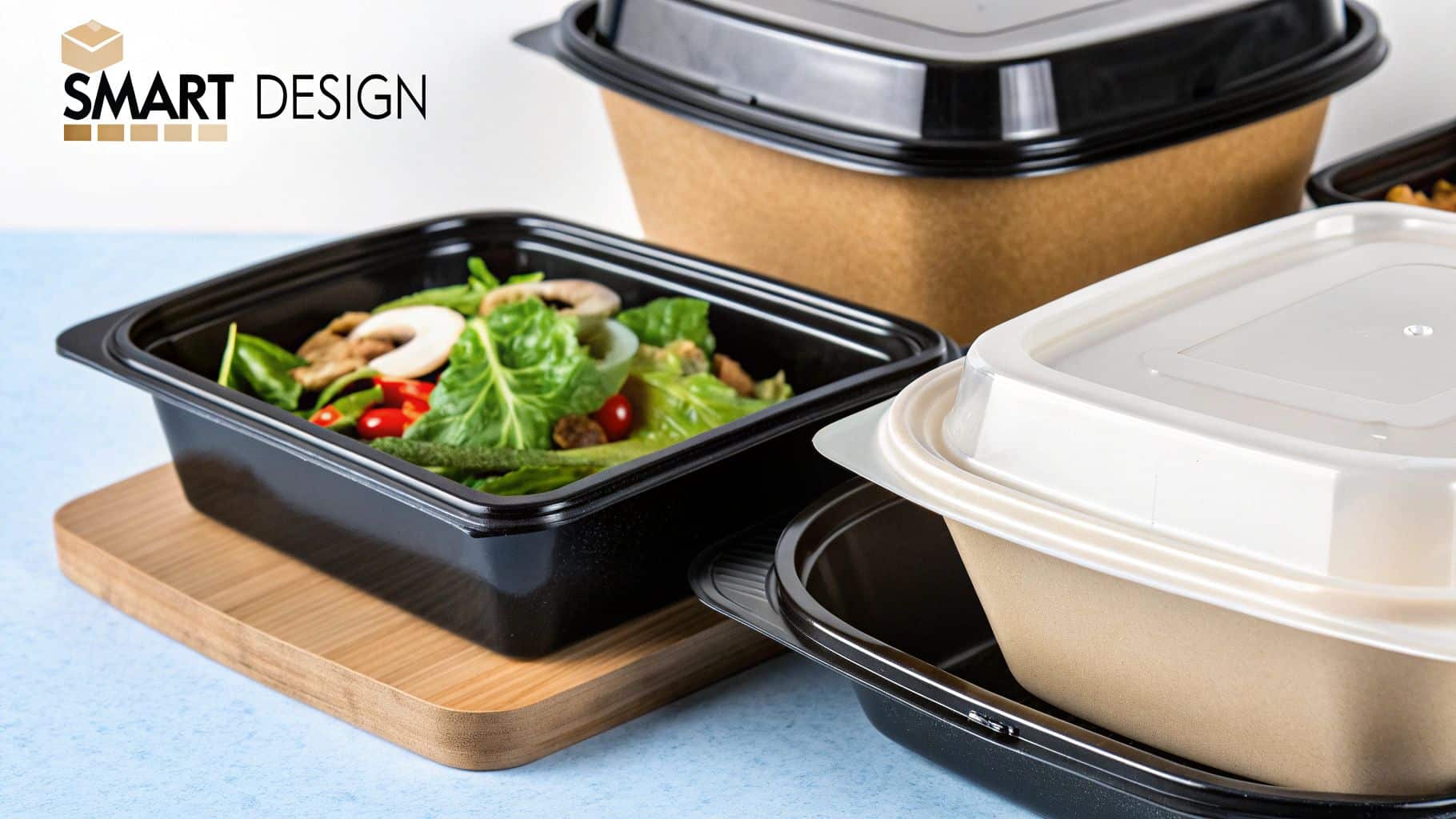
The most eco friendly disposable food containers are generally certified-compostable molded fiber (bagasse), bamboo fiber, and uncoated or plant-lined paperboard. Recyclable polypropylene (PP #5) plastic and aluminum also qualify where local recycling accepts them. No single material wins everywhere. The right pick depends on how hot the food is, how much sauce or grease it carries, and what your customers can do with the container afterward: recycle it, send it to a commercial composter, or throw it away.
This guide is written for restaurant, deli, caterer and food truck operators. It compares every common disposable material on three points: environmental claims, food safety and day-to-day performance. If you only want a shortlist of top picks for to-go orders, see our roundup of the best eco-friendly takeout containers.
What Counts as Eco Friendly Disposable Food Containers?
“Eco-friendly” has no single legal definition. The FTC’s Green Guides tell marketers not to make broad, unqualified “green” or “eco-friendly” claims. A specific claim is what matters, and these are the three you will see most:
- Recyclable: the container can be collected and turned into new material. In practice, it only gets recycled if your local program accepts that material and the container is reasonably clean.
- Compostable: the container breaks down into compost under defined conditions, usually in an industrial composting facility. Under the Green Guides, compostable claims should be qualified if the item cannot be composted at home or if commercial composting is not available to a substantial majority of consumers.
- Biodegradable: the material will eventually break down through natural processes. The word alone does not tell you how long that takes or under what conditions, which is why it is the weakest of the three claims.
Certification labels worth checking
For compostable packaging, the most common U.S. mark comes from BPI. BPI certifies products against ASTM D6400 (for compostable plastics) and ASTM D6868 (for coatings on paper and fiber). Certified items must reach at least 90% disintegration within 12 weeks under industrial composting conditions. Only products with BPI’s separate Home Compostability certification are designed for backyard bins.
On plastics, the number inside the chasing-arrows triangle is a resin identification code (#1 PET, #5 PP, #6 PS). It tells you the type of plastic. It does not promise that your local program accepts it.
Types of Disposable Food Containers Compared
Disposable food containers fall into seven main material groups. The table below gives a quick side-by-side view. Always confirm heat, microwave and disposal details on the specific product’s label, because coatings and formulations vary.
| Material | Hot / Cold Use | Leak and Grease Resistance | Microwave | Typical End of Life | Relative Cost |
|---|---|---|---|---|---|
| PET plastic (#1) | Cold only | Good with a tight lid | No | Recycle where accepted | Low |
| PP plastic (#5) | Hot and cold | Very good | Often yes (check label) | Recycle where accepted | Low to medium |
| Aluminum | Hot and cold, oven use | Good, lid fit varies | No | Recycle where accepted | Medium |
| Paperboard / kraft | Hot and cold (depends on lining) | Fair to good with a coating | Depends on lining (check label) | Recycle or compost, depending on coating | Low to medium |
| Foam (EPS #6) | Hot and cold, insulating | Good | Generally not recommended | Mostly landfill | Low |
| Molded fiber / bagasse | Hot and cold | Good grease resistance, softens with long liquid holds | Often yes (check label) | Commercial compost if certified | Medium |
| Bamboo fiber | Hot and cold | Good for moderately wet or oily food | Often yes (check label) | Commercial compost if labeled compostable | Medium to higher |
| PLA (plant-based plastic) | Cold (standard PLA) | Good with a tight lid | No for standard PLA | Industrial compost only | Medium to higher |
| Material Type | Heat Resistance | Moisture Resistance | Food Compatibility | Environmental Impact | Cost Range |
|---|---|---|---|---|---|
| Plastic | Varies widely depending on the type of plastic; some are microwave-safe | Generally good; some types offer excellent leak-proof properties | Compatible with a wide range of foods | Can be a concern due to its persistence in the environment; some types are recyclable | Low to moderate |
| Aluminum | Excellent; suitable for oven use | Excellent; provides a barrier against moisture and oxygen | Suitable for baking and reheating various foods | Recyclable; production is energy-intensive | Moderate |
| Paperboard | Limited; not suitable for high temperatures | Moderate; can be susceptible to leakage if not properly coated | Suitable for dry and less greasy foods | Biodegradable and often made from recycled materials; compostable | Low |
| Foam | Excellent insulation properties | Good; generally leak-proof | Suitable for hot beverages and takeout food | Not environmentally friendly due to slow decomposition; some areas have banned its use | Low |
| Molded Fiber | Good; can handle moderate heat | Fair; improving with newer technologies | Suitable for a wide range of foods, including hot and cold items | Compostable and made from renewable resources | Moderate to high |
Plastic: PET vs PP
PET (#1) is the clear, rigid plastic used for salad clamshells, parfait cups and deli trays. It shows food well and suits cold items, but it is not made for hot food or microwaving. PP (#5) is the workhorse for hot takeout: it handles heat better, many PP containers are labeled microwave safe, and it seals well for soups and sauces. Both are recyclable in many areas, though acceptance of food containers varies by program. Browse our plastic takeout and lunch box containers to compare PP and PET styles.
Aluminum
Aluminum pans and trays are the standard for catering, family meals and anything that will be reheated in a conventional oven. They conduct heat well and stand up to rich, saucy dishes. They cannot go in the microwave. Aluminum is widely recyclable when it is reasonably free of food residue, which makes it a strong choice where recycling is available.
Paperboard and Kraft
Folded paperboard boxes, kraft bowls and soup cups are light, printable and familiar to customers. Their performance and end of life depend on the lining. A plastic (PE) lining improves leak resistance but complicates composting, while aqueous or plant-based linings may be recyclable or compostable depending on how they are certified. Our kraft paper takeout bowls are a common pick for grain bowls, noodles and soups.
Foam (EPS)
Expanded polystyrene foam is cheap, light and insulates well, which is why it held the takeout market for decades. It is rarely accepted in curbside recycling, and a growing number of states and cities restrict foam foodservice containers. If you still use foam, check your local rules before reordering.
Molded Fiber and Bagasse
Bagasse is the fiber left after sugarcane is pressed for juice. It is pulped and molded into clamshells, plates and bowls that handle hot, greasy food well. Certified versions can go to commercial composting. Two practical notes: fiber can soften if liquid sits in it for a long time, and some older molded fiber relied on PFAS-based grease-proofing (see the safety section below), so ask your supplier for PFAS-free documentation.
Bamboo
Bamboo comes from a fast-growing grass, and bamboo fiber blends are used much like bagasse for clamshells and boxes. Our #3 bamboo compostable takeout containers are made of bamboo and corn kraft with a PLA compostable window. They are labeled PFAS free, BPA free, and microwave and moderate heat lamp resistant. A tamper-evident seal comes with every box. You can see the full range of bamboo compostable takeout boxes in our store.
PLA
PLA (polylactic acid) is a plastic made from plant sugars such as corn. It looks and feels like PET, which makes it popular for clear cold cups, salad clamshells and windows on fiber boxes. Standard PLA is meant for cold food. Heat-resistant versions (often labeled CPLA) exist, so check the label. PLA needs industrial composting, not a backyard bin, and it can contaminate plastic recycling if customers mistake it for PET.
Biodegradable vs Compostable Food Containers: What the Labels Mean
Many buyers search for biodegradable food containers when what they want is compostable ones. The difference matters. “Biodegradable” on its own is an open-ended claim. Almost everything biodegrades eventually, but in a landfill, with little oxygen, that can take a very long time.
“Compostable” is narrower and testable. A container certified to ASTM D6400 or D6868 has been shown to break down within a set time in an industrial composting facility. That is a real advantage when your customers or your local hauler can get the container to such a facility.
| Container Type | Industrial Composting Time | Home Composting Time | Marine Environment Breakdown | Landfill Breakdown |
|---|---|---|---|---|
| PLA (Polylactic Acid) | 6-12 weeks | 6 months – 2 years | 6 months – 2 years | Decades |
| Bagasse | 4-6 weeks | 3-6 months | 3-6 months | Decades |
| Bamboo | 6 months – 2 years | 1-3 years | 1-3 years | Decades |
| Conventional Plastic | Does not decompose | Does not decompose | Hundreds of years | Hundreds of years |
Here is how to use that in practice:
- If your area has commercial composting that accepts food packaging, certified-compostable fiber, bamboo or PLA can go to compost along with the food scraps.
- If your area has no composting access but accepts PP or aluminum, a recyclable container may have the better end of life.
- If neither option exists, compare containers on what they are made from (renewable fiber vs petroleum plastic) and choose sizes that avoid waste. Skip containers that rely only on an unqualified “biodegradable” claim.
How to Choose Disposable Food Containers by Food Type
Start with the food, then narrow by disposal options. This table maps common menu categories to materials and container styles that hold up.
| Food Type | Recommended Material | Container Style |
|---|---|---|
| Soups, curries, saucy dishes | PP plastic or lined kraft paper | Round bowl or deli container with a tight-fitting lid |
| Fried and greasy food | Molded fiber, bamboo or grease-resistant kraft | Vented clamshell or folded box |
| Salads and cold items | PET, PLA or kraft | Clear clamshell or kraft bowl with a clear lid |
| Hot entrées | PP, molded fiber, bamboo, kraft; aluminum for catering | Clamshell, take out box or foil pan |
| Multi-item meals | PP plastic or compartment molded fiber | Two- or three-compartment container |
Soups and saucy food
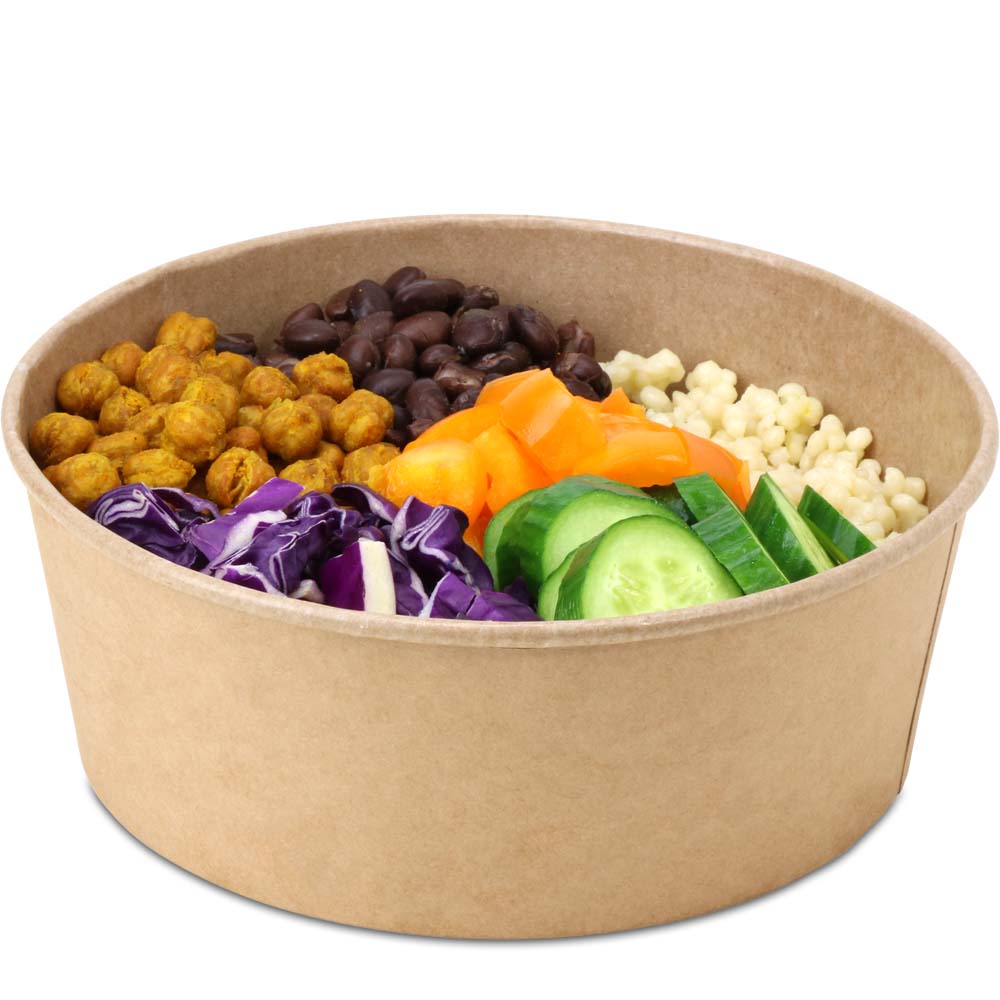
Liquid is the hardest test for any disposable. Look for a container whose product description specifically states leak resistance, and pair it with the matching lid. The 38 oz. round kraft takeout bowl is a coated kraft bowl described as leak proof, microwaveable, PFAS free, petroleum free and recyclable. Lids are sold separately.
Fried, greasy and hot entrées
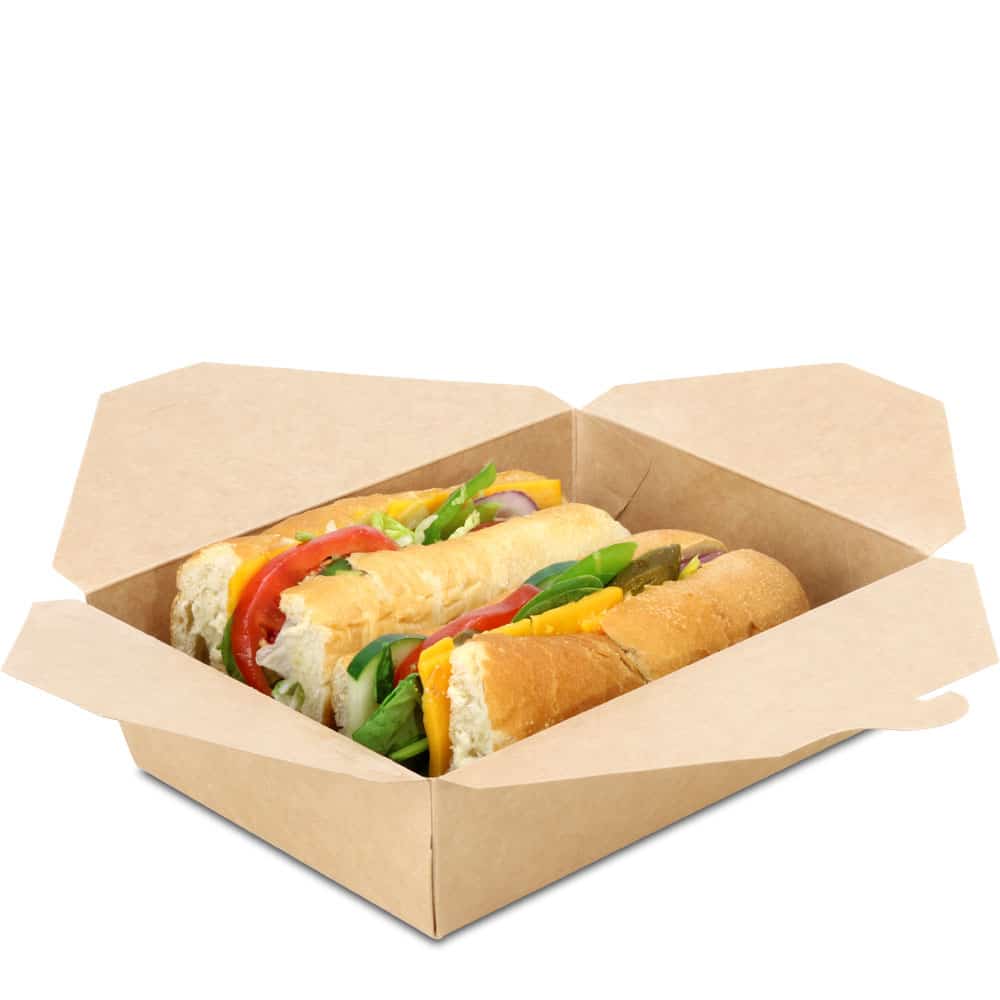
Fried food needs two things: grease resistance and a way for steam to escape so the crust does not go soggy. Fiber and kraft boxes with vented closures work well here.
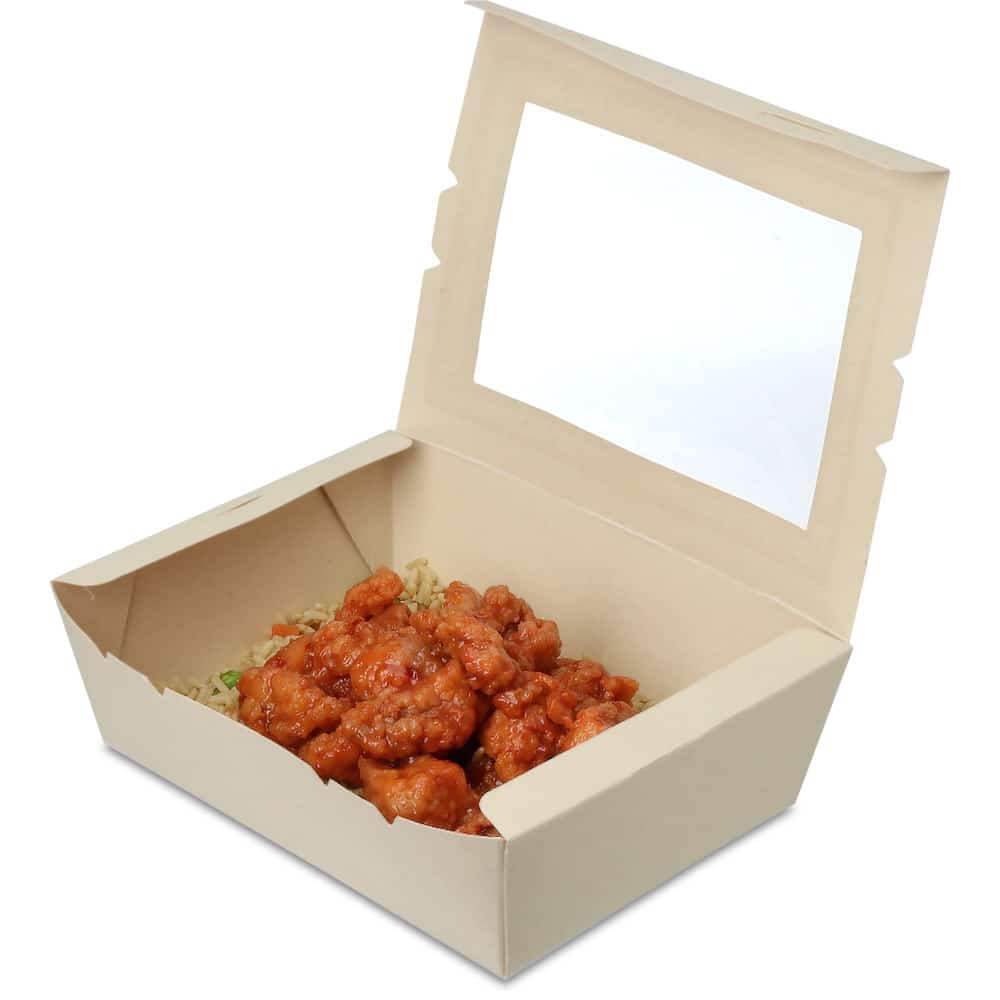
The #3 kraft Bio Box is a one-piece kraft takeout box described as grease resistant, microwave safe, freezer safe, PFAS free and recyclable. Its locking lid allows ventilation to reduce condensation from hot foods.
Multi-item meals
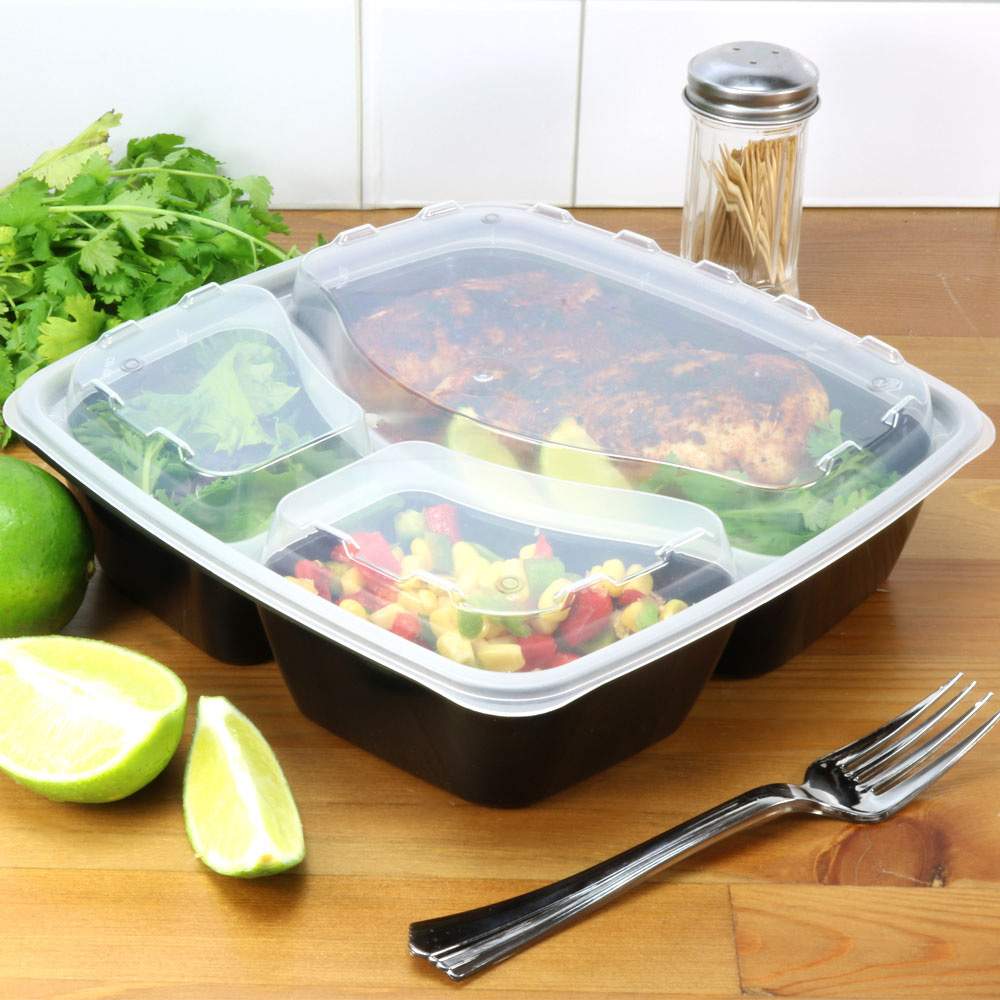
Compartments keep sauces off rice and fries off salad. The 48 oz. three-compartment container is recyclable type 5 (PP) and is listed as microwave, dishwasher and freezer safe. Its lid seals each compartment separately, and pop-out vents release steam, though opening the vents reduces leak resistance.
Food Safety Checklist for Disposable Packaging
A greener container only helps if it also keeps food safe. Run new containers through this checklist before you switch. For a deeper look, read our guide to food safe packaging.
- Food-contact compliance: buy from suppliers who state that their materials are made for food contact, and keep spec sheets on file in case your inspector asks.
- PFAS-free documentation: in February 2024 the FDA announced that grease-proofing substances containing PFAS are no longer being sold by manufacturers for food-contact use in the U.S. That was a voluntary market phase-out, so older stock and imports may still differ. Ask for a PFAS-free statement on fiber and paper items.
- Heat limits: follow the manufacturer’s label for microwave, oven and heat lamp use. Do not put PET, standard PLA or foam in the microwave unless the label says otherwise.
- Holding temperatures: the FDA Food Code, which serves as a model for state and local rules, calls for holding hot food at 135°F (57°C) or above and cold food at 41°F (5°C) or below. Local codes vary, so check with your health department.
- Time out of temperature: perishable food should not sit out more than 2 hours, or 1 hour above 90°F. Factor delivery time into your packaging choice.
- Venting for steam: trapped steam softens fiber and makes fried food soggy. Use vented lids for hot, crispy items, and keep vents closed for liquids.
- Tamper evidence: California AB 3336 requires food facilities to close bags or containers of ready-to-eat food going out through third-party delivery platforms with a tamper-evident method before the driver takes possession. Other areas may have their own rules, so check locally.
- Single use means single use: do not wash and reuse disposables for service, and store unused stock in a clean, dry area.
Disposable Food Packaging Market and Trends
Research firms publish estimates of the disposable food containers market, including separate figures for the compostable food service disposables segment. Those estimates differ widely depending on how each report defines the market, so we are not quoting a single number here. If you need a figure for a business plan or investor deck, cite a named report and note its scope.
The direction of the market is clearer than its size:
- PFAS phase-out: the FDA’s 2024 announcement means grease-resistant paper and fiber now has to rely on other barrier methods.
- Foam restrictions: more states and cities limit EPS foam foodservice containers, which pushes operators toward fiber, paper and PP.
- The shift to fiber: bagasse, bamboo and kraft are now mainstream for hot and greasy takeout, not a specialty item.
- Closer scrutiny of green claims: the FTC Green Guides push brands toward specific, qualified claims such as “commercially compostable” instead of vague “eco” language.
Where to Buy Disposable Food Containers
We carry wholesale cases of every material covered here. Start with our full selection of take out boxes and to go boxes, then filter by size and style. Use the tables above to match each menu item to a material, and order samples before you change a high-volume item.
Frequently Asked Questions
What are eco friendly disposable food containers?
Eco friendly disposable food containers are single-use containers with a credible, specific environmental attribute. Common examples are certified compostability, recyclability in common local programs, or renewable plant-based materials. Bagasse, bamboo fiber, plant-lined paperboard, PP plastic and aluminum are the most common options. The best fit depends on your food and on the disposal options your customers have.
Are biodegradable containers for food actually better for the environment?
Not automatically. “Biodegradable” alone does not say how long breakdown takes or under what conditions, and landfills slow the process a great deal. Containers certified compostable (ASTM D6400 or D6868) are a better bet where commercial composting is available. Where it is not, a recyclable PP or aluminum container may have the better end of life.
What is the best eco-friendly disposable food packaging for hot food?
Molded fiber, bamboo fiber and lined kraft containers handle most hot entrées well, and PP plastic is a strong recyclable option for soups and saucy dishes. For fried items, choose a vented or grease-resistant container so steam escapes. Check the product label for heat lamp and microwave guidance.
Is food in disposable packaging safe to microwave?
Only if the container is labeled microwave safe. PP plastic and many fiber and kraft containers carry that label. PET, standard PLA, foam and aluminum generally should not go in the microwave. When in doubt, transfer the food to a microwave-safe dish.
How big is the disposable food containers market?
Market research firms publish estimates, but the figures vary widely by definition and method. We do not cite a single number for that reason. If you need one, use a named research report and note what it includes. The clearest trends are the move away from foam and PFAS toward fiber and recyclable plastics.
What are the best compostable takeout containers?
Certified-compostable bagasse and bamboo fiber clamshells are the most versatile choices for hot and greasy takeout. PLA works for cold, clear applications. All of them need a commercial composting facility unless they carry a home compostable certification. Our guide to compostable food containers covers certifications and disposal in more depth.
Choosing a disposable container comes down to three questions: what the food needs, what your local recycling or composting accepts, and what your customers will actually do with the container. If you are ready to compare fiber, bamboo and recyclable options side by side, browse our eco friendly food packaging category.


Comments are closed.